The usual challenge rules
Each firm has its own rules, and they change: always read the terms of your challenge. You will usually find:
| Rule | Common value | What to track |
|---|---|---|
| Profit target | often 8–10% in phase 1 | Distance remaining |
| Max daily loss | often 5% | Room left today, open positions included |
| Max overall loss | often 10%, static or trailing | Absolute account floor |
| Minimum trading days | varies | Days already traded |
Daily loss: a worked example
100,000 account, daily loss limited to 5% of initial balance, i.e. 5,000. This morning, the day's starting balance is 101,200. The day's floor is therefore 101,200 − 5,000 = 96,200.
Careful: at many firms, the limit applies to floating losses (equity), not just closed trades. An open position going against you can fail the challenge before it is even closed.
Max overall loss: static or trailing
- Static: 10% of 100,000, floor at 90,000, which never moves.
- Trailing: the floor rises with the highest balance reached. With a 10,000 trailing distance (10% of the initial balance), an account that peaked at 104,000 has its floor at 94,000. Some firms stop trailing once the initial balance is reached.
Calculate your real room for the day
The floor that matters is the higher of the two. With the static rule: MAX(96,200, 90,000) = 96,200. If current equity is 98,000, you have 1,800 of room left today.
Daily floor   : =B2-5%*B1        (B1 = initial balance, B2 = day's starting balance)
Overall floor : =B1*(1-10%)
Room left     : =B3-MAX(C2,C3)   (B3 = current equity)
Risking 0.5% of the account per trade (500), that room covers 3 full losses (1,800 / 500 = 3.6). That is what you need to know before opening a trade, not after. To size each trade with fees included, use our position size calculator.
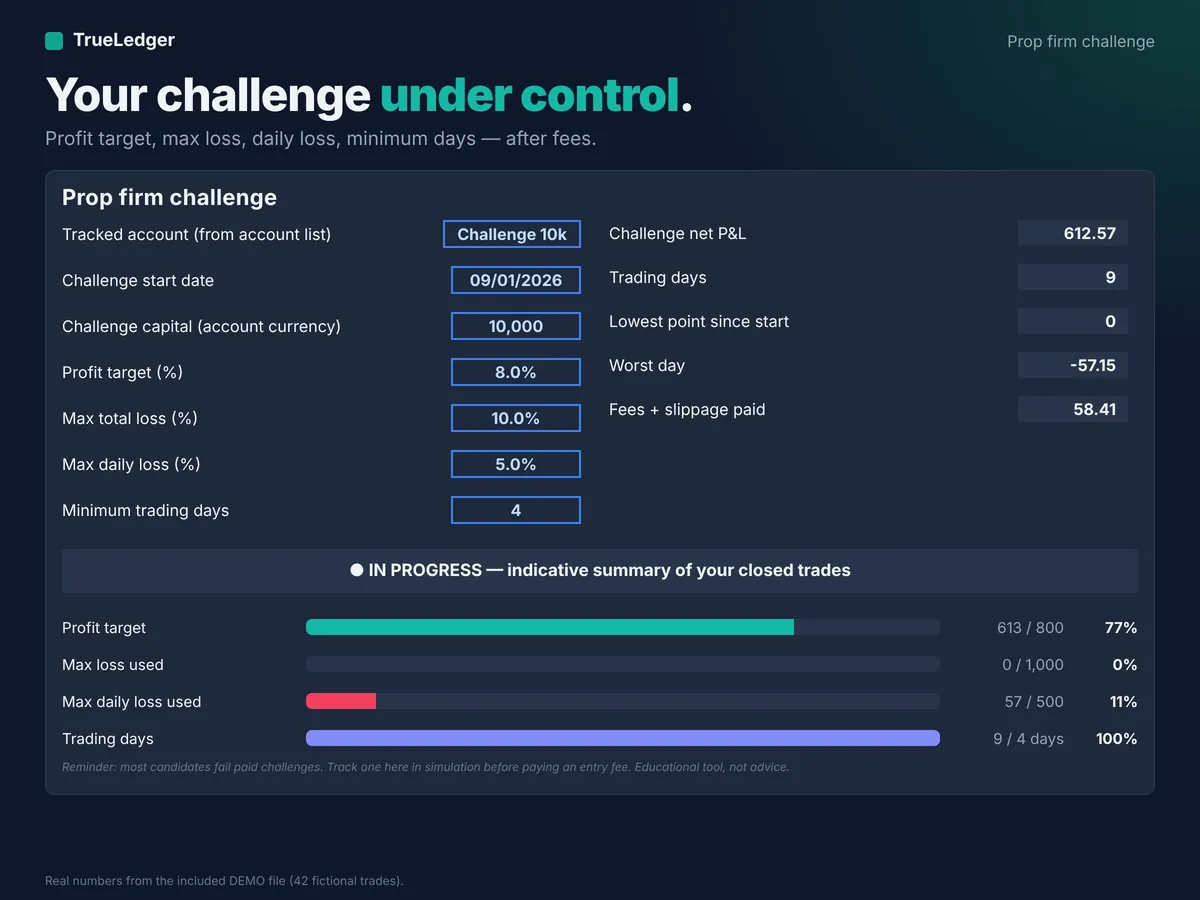
Fees count too
Commissions and swaps are deducted from the challenge account. A 10% target is therefore judged on net P&L. See our guide how to calculate net P&L after fees.
A simple routine during the challenge
- Before the session: note the day's starting balance and calculate both floors.
- Before each trade: check the risk fits within the room left.
- After the session: log trades, update the distance to target and the days traded.
Running several challenges at once? Our Prop Firm Challenge Tracker, in the same Etsy shop, is built for that.
The ready-made template
TrueLedger does all of these calculations for you in Excel or Google Sheets: net P&L after fees and slippage, expectancy, profit factor, max drawdown, discipline and challenge tracking. DEMO file included.
View the journal on Etsy →